
Make Better Trade DecisionsBefore You Ship.
Simulate international trade scenarios, assess compliance and operational risks, estimate potential costs, and compare corrective actions before committing to a shipment.
- Simulate international trade scenarios before carrier booking
- Assess customs, dual-use, and sanctions compliance rules
- Estimate total landed costs, duty exposure & potential penalties
- Compare corrective actions and alternative routes side-by-side
Designed for global trade teams:
Everything You Need to Know at a Glance
Understand how Decitrayd transforms reactive shipment firefighting into predictive, profitable trade decisions.
Pre-Shipment Trade Simulation
Decitrayd stress-tests international shipment drafts against multi-jurisdiction compliance rules, deterministic duty/tax engines, and trade lane operational factors before carrier booking.
✓ Pre-booking risk, cost, and delay evaluation in minutes.
Built for Trade Operators
Designed specifically for Freight Forwarders, Customs Brokers, Global Exporters, Importers, and Enterprise Supply Chain Leaders handling high-volume or regulated cross-border freight.
✓ Aligns operations, finance, and trade compliance teams.
The Reactive Border Trap
Eliminates customs holds, unexpected demurrage, duty leakage, and regulatory penalties that conventional workflows only discover after cargo is committed or stranded at the border.
✓ Stops costly surprises before commitments are signed.
Scenario Modeling & Comparison
Test alternative trade routes, incoterms, documentation packages, and HS code classifications side-by-side to select the lowest-risk and most profitable trade path before shipping.
✓ Data-backed confidence before executing any shipment.
0+
Statutory Trade Rules
0+
Risk & Cost Drivers
0
Interconnected Engines
0+
Trade Corridors on Roadmap
Pre-Shipment Decision Workflow
Scroll through all 5 workflow stages to inspect each decision card and its corresponding platform screen.
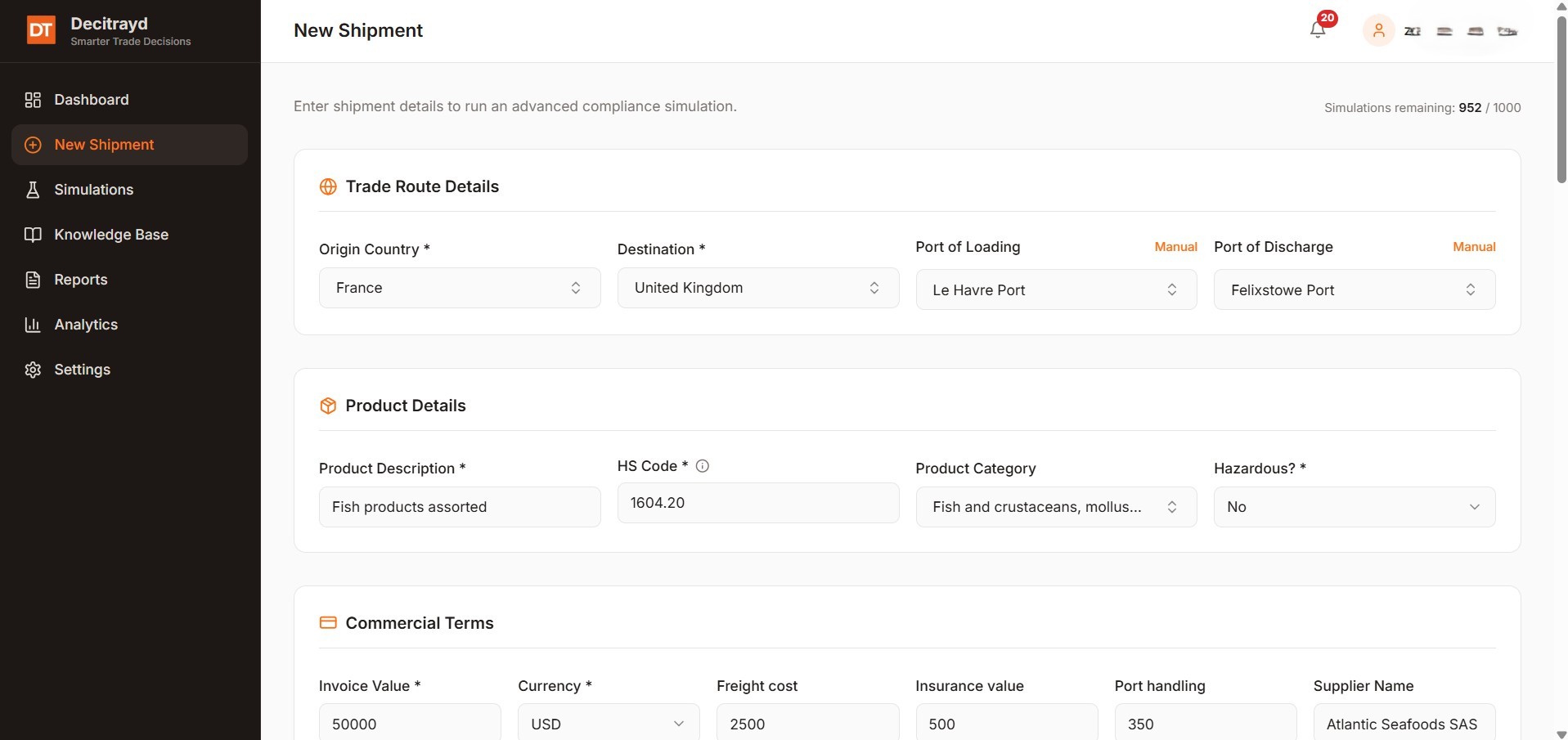
Trade & Shipment Inputs
Users provide relevant shipment, route, product, origin, destination, HS 7318.15 classification, Incoterm structures (CIF vs CIP vs FOB), cargo valuation, and commercial shipping documents before booking.
100% parameter capture across commercial & operational terms
- Origin & Destination Port pair validation (Nhava Sheva ⇄ Felixstowe)
- 6-to-10 digit HS code classification & sub-heading rules
- Incoterm obligation boundary & cargo insurance adequacy
- Commercial document sufficiency check (Invoice + Packing List)
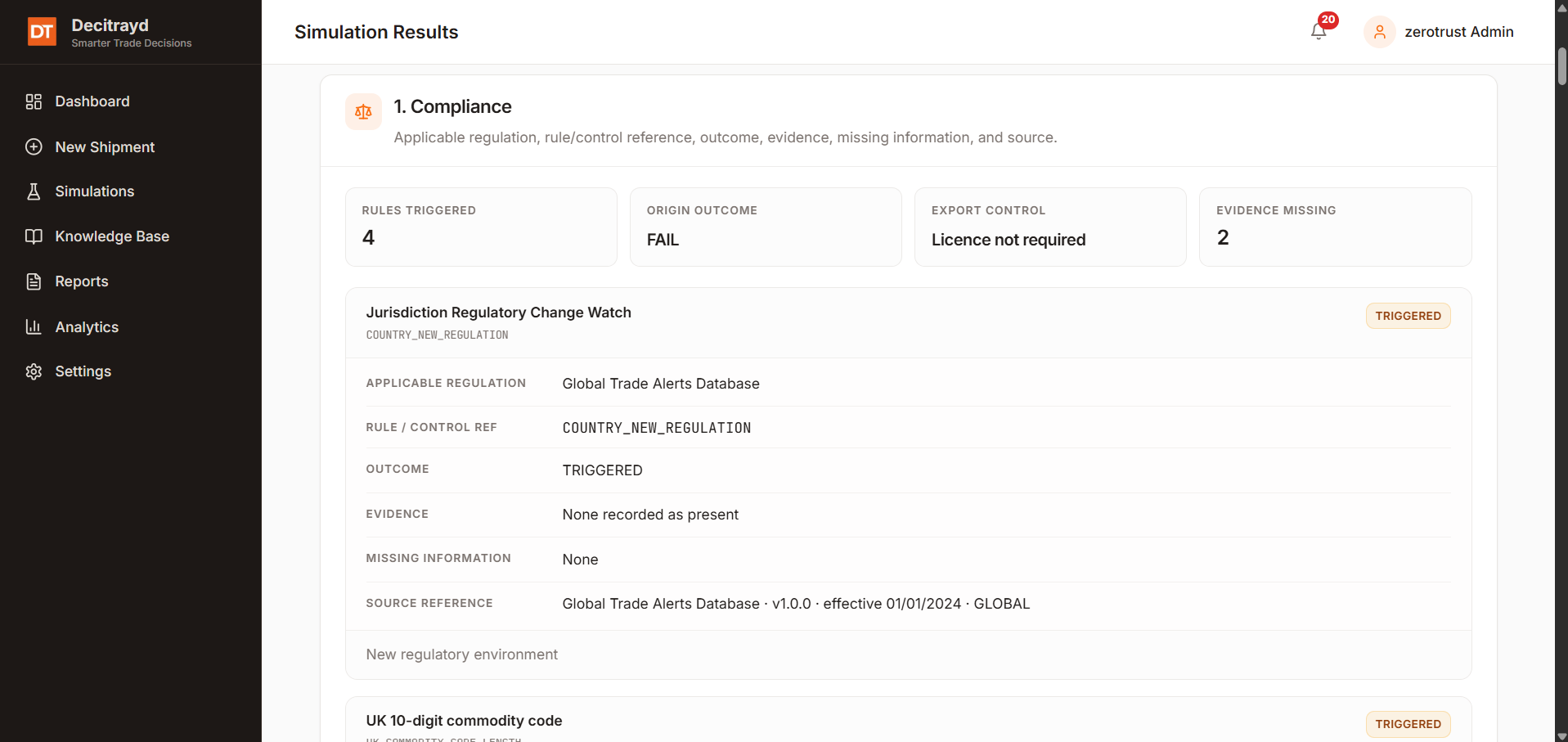
Rules & Compliance Checks
The platform evaluates applicable statutory trade rules and multi-agency compliance requirements: UK CDS customs procedure codes, SPIRE dual-use export controls, UK REACH chemical registries, and preferential Rules of Origin (RoO) protocols.
100% transparent citations to HMRC & DGFT tariff manuals
- Document Code 9100 series waivers & UK REACH chemicals
- Preferential Rules of Origin (RoO) value-add proof audit
- Mandatory 10-digit CDS commodity code specificity verification
- Dual-use strategic goods screening against SPIRE export controls
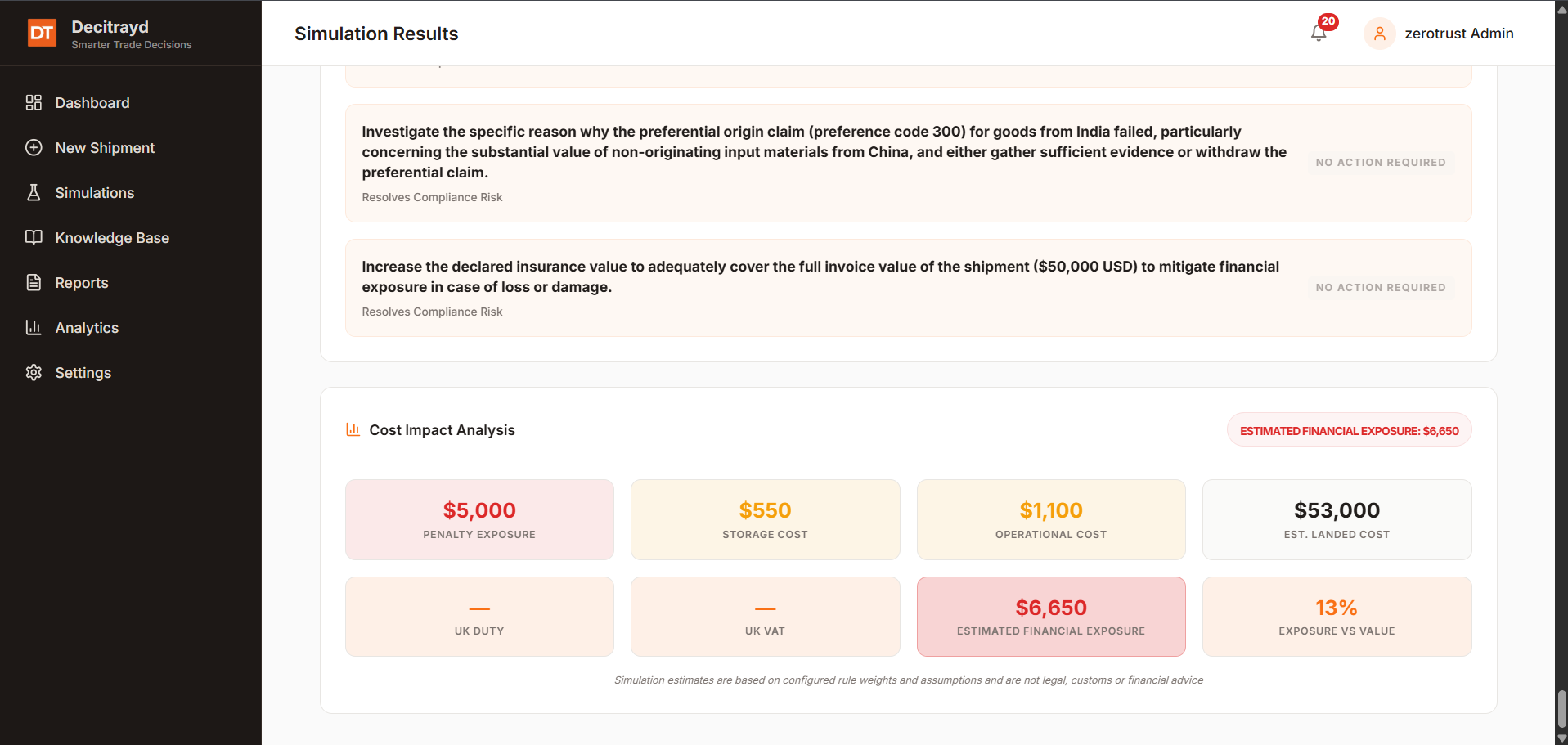
Risk & Cost Assessment
The system assesses relevant operational risks and potential cost implications: calculates deterministic risk scores (0–100%), projects landed duties, flags VAT liabilities, and forecasts port congestion dwell-time.
Quantifies landed exposure, demurrage risks, and 2–3 days potential delay
- Transparent risk score with contributing factor weighting (31% Exposure)
- UK Third-Country duty rate & landed cost estimation ($1,665)
- Port delay forecast based on lane congestion & missing documents
- 85% Shipment Clearance Readiness index before carrier booking
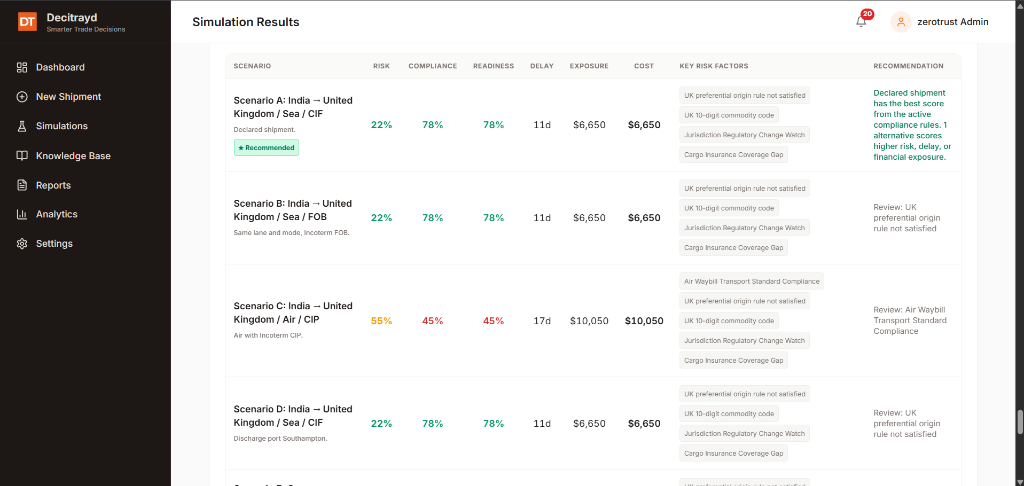
Scenario Comparison
Users compare alternative trade or shipment scenarios side-by-side: test shifting between Sea/CIF vs Air/CIP, evaluate alternative discharge ports, or contrast preferential origin duty savings before committing.
Identifies optimal route & Incoterm combination prior to carrier commitment
- Side-by-side variance of baseline Sea CIF ($6,650) vs Air CIP ($10,050)
- Buyer vs seller liability shift across Incoterm structures
- Alternative discharge port dwell-times and customs hold rates
- Exposure differential modeling to protect gross shipment margins
Recommendations & Corrective Actions
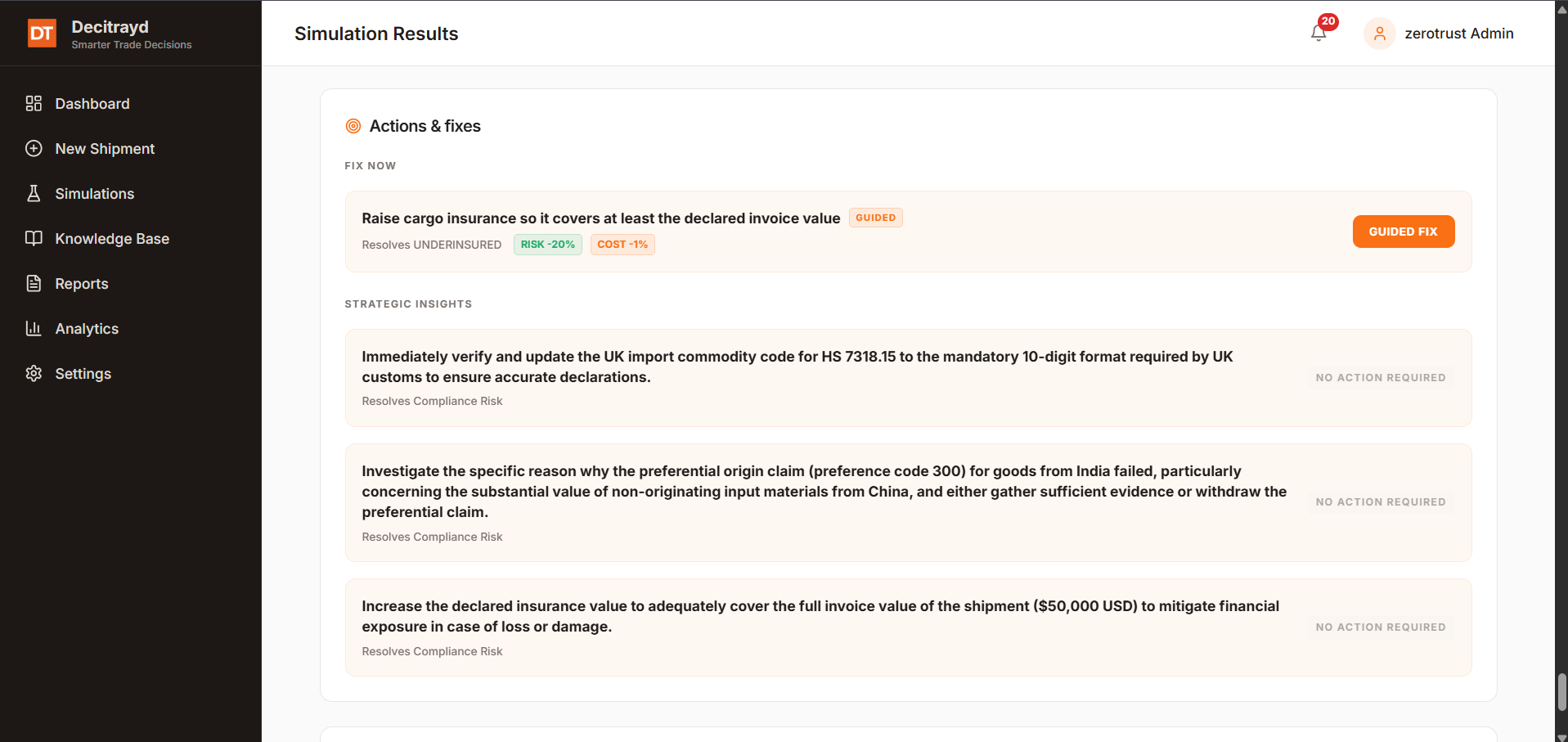
The platform presents actionable, ranked recommendations based on simulation results: guides 1-click parameter corrections, generates missing document checklists, and drops shipment risk from 77% to 22% instantly.
Actionable 1-click fixes lower consignment exposure from Critical to Safe
- Ranked remediation sequence targeting highest financial & delay drivers
- 1-click parameter corrections for CDS Customs Procedure Codes
- Missing document checklist generation (COO & Chemical Declarations)
- Instant re-simulation verifying 100% green-channel clearance
Trade & Shipment Inputs
Users provide relevant shipment, route, product, origin, destination, HS 7318.15 classification, Incoterm structures (CIF vs CIP vs FOB), cargo valuation, and commercial shipping documents before booking.
100% parameter capture across commercial & operational terms
- Origin & Destination Port pair validation (Nhava Sheva ⇄ Felixstowe)
- 6-to-10 digit HS code classification & sub-heading rules
- Incoterm obligation boundary & cargo insurance adequacy
- Commercial document sufficiency check (Invoice + Packing List)
Why Decitrayd Is Different
Traditional tools track shipments after departure or check compliance rules in silos. Decitrayd unifies simulation, compliance, and cost modeling before you commit.
Conventional Shipment Tracking
GPS and carrier tracking tools report where a container is after it leaves the port. While useful for visibility, they only notify you after delays, demurrage fees, or customs inspections have already occurred — when costs are irreversible.
Limitation: 100% reactive. Cannot prevent border holds or optimize trade decisions before booking.
Standalone Compliance Software
Static compliance tools offer isolated lookups for HS codes or denied parties. They operate in a silo without calculating financial landed cost impact, estimating port delay risks, or testing "what-if" trade route alternatives.
Limitation: Disconnected data lookups with no predictive cost modeling or multi-scenario comparison.
Decitrayd Decision Platform
Decitrayd acts as the decision intelligence layer before you commit. It simulates multi-jurisdiction rules (customs, dual-use, sanctions, RoO), projects total financial exposure, and lets you compare corrective scenarios side-by-side before shipping.
The Decitrayd Edge: Proactive prevention, deterministic cost forecasting, and actionable decision comparison.
Feature-by-Feature Comparison
How Decitrayd compares against conventional tracking and standalone compliance databases.
Intervention Timing
Decitrayd EdgeScenario Simulation
Decitrayd EdgeCustoms & Dual-Use Rules
Decitrayd EdgeFinancial Exposure Modeling
Decitrayd EdgeOperational Delay Prediction
Decitrayd EdgeDecision Comparison & Fixes
Decitrayd Edge| Capability | Conventional Tracking | Standalone Compliance | Decitrayd Platform |
|---|---|---|---|
| Intervention Timing | Post-dispatch (in-transit only) | Ad-hoc lookup during filing | Pre-shipment (before any commitment) |
| Scenario Simulation | None (reports physical coordinates) | None (static single-code queries) | Full multi-variable scenario modeling |
| Customs & Dual-Use Rules | Not covered | Isolated lists without trade context | Deterministic multi-jurisdiction rules engines |
| Financial Exposure Modeling | None (demurrage costs discovered after) | No cost, duty, or penalty calculations | Full landed duty, VAT, penalty & delay cost forecast |
| Operational Delay Prediction | Historical reporting after port congestion | No operational timeline awareness | Predictive lane delay days & clearance risk scoring |
| Decision Comparison & Fixes | None | Manual research & external advisory | Side-by-side scenario diffing & ranked 1-click fixes |
Technology & Product Innovation
Decitrayd is being developed around interconnected components that work synchronously to support pre-shipment trade decision-making — combining rule-based compliance, risk scoring, cost modeling, scenario simulation, and corrective actions in a single unified workflow.
Rules Engine
Evaluates configurable trade and compliance conditions
Parses multi-agency statutory trade regulations deterministically. Evaluates 6-to-10 digit HS commodity codes, procedure codes, dual-use export screening lists, and origin criteria with 100% legal attribution.
Risk Engine
Assesses relevant risk factors
Synthesizes regulatory, documentation completeness, and port congestion factors into an explainable 0–100% risk score. Categorizes severity into actionable tiers without opaque black-box guessing.
Cost Engine
Evaluates potential cost implications
Performs line-item statutory calculations of customs duties, trade taxes (VAT/IGST), and potential port demurrage detention liability under different commercial Incoterms and valuation methods.
Scenario Simulation
Enables comparison of alternative decisions, where supported by current implementation
Stress-tests alternative execution options side-by-side prior to capital commitment. Operators evaluate how shifting ports of discharge, transport modes, or Incoterms impacts overall landed feasibility.
Recommendation Engine
Helps identify possible corrective actions
Translates complex statutory flags and cost spikes into prioritized, explainable operational remedies. Provides guided parameter adjustments, document checklists, and 1-click re-simulation workflows.
Future Platform Evolution
Roadmap Expansion Beyond Initial UK–India Focus
To maintain transparency, Decitrayd distinguishes demonstrable release functionality from planned development. Future phases expand corridor coverage and deepen automated integrations.
Transparent Platform Evolution & Capability Roadmap.
A milestone-driven progression outlining how Decitrayd deepens statutory intelligence, multi-corridor coverage, and enterprise connectivity.
Core Platform
The foundation focuses on deterministic statutory customs evaluation and immediate risk visibility before booking.
- Core rules and compliance evaluation.
- Initial risk and cost assessment.
- Demonstrable trade scenario workflow.
Enhanced Decision Intelligence
Deepening trade scenario capabilities with comparative Incoterm modeling and line-by-line legal attribution.
- Expanded rules and trade scenario coverage.
- Improved scenario comparisons.
- More detailed recommendations and explainability.
Scale and Integrations
Expanding to bilateral global corridors and direct connectors for enterprise logistics and customs filing ecosystems.
- Broader trade corridor coverage.
- Integrations with relevant trade, logistics, or data sources.
- Enhanced reporting and enterprise capabilities.
Enterprise Security. Statutory Transparency.
Trade data contains proprietary commercial intelligence. We protect it with zero-trust isolation and absolute statutory transparency.
Zero-Trust Data Isolation
Your trade margins, invoice valuations, and supplier agreements are encrypted and isolated per tenant. No customer trade data is ever shared across organizations or fed into public machine learning models.
Statutory Source Grounding
Every compliance rule and duty schedule is directly grounded in formal public regulatory authorities: HM Revenue & Customs (HMRC CDS), Indian CBIC Customs Schedules, and WTO valuation principles.
Non-Custodial Decision Logic
Decitrayd operates as a decision simulation layer. We do not act as the customs declarant of record or escrow carrier funds, preserving complete autonomy for your in-house brokers and logistics partners.
Decision Support Platform Scope
Decitrayd is an algorithmic trade simulation and risk intelligence platform engineered to assist international trade operators in assessing scenario feasibility, landed cost impact, and compliance exposure prior to shipment dispatch.